Rumi Forum's blog on Hizmet, Fethullah Gulen, peacebuilding, education and interfaith efforts.

Friday, March 14, 2014

Rumi Forum Internships Available for Summer 2014

Employment & Internship

Currently Available Internship Opportunities at Rumi Forum

Internship Program

We are always considering applications for our internship program (dates are flexible and negotiable)

Eligibility: All undergraduate and master’s-level students and J.D. and Ph.D. candidates as well as recent graduates are eligible to apply.

Application Process: In order to apply for a Rumi Forum Internship, please fill out this application form. You may send any supporting documents such as CVs, resumes etc to internships@rumiforum.org . Please note that you need to fill out the application form first before sending any documents.
Available Internship Positions
  • Project Internship
  • Multimedia Internship
  • Web Design Internship
  • Public Relations Internship

Project Internships

The responsibility of the interns of these centers will be about general projects  of Rumi Forum including organization of luncheon  and ambassador speaking series, conferences, seminars, trips to Turkey and social responsibility projects.
Requirements:
Pursuing an undergraduate degree in International Relations, Public Policy, Political Science,  Sociology, Journalism, Communications, or other related fields in the social sciences and arts.
Duties may include the following:
  • Reaching prominent government, corporate and media officials, opinion-makers, academics, diplomats, clergy and other civic leaders
  • Making invitee lists, preparing and sending hard copy and email invitations
  • Maintaining contacts database
  • Checking the venue ready for the Forum and working with catering
  • Working with Photographer and Cameraman
  • Having interviews
  • Editing speeches and interviews, preparing news updates for the website working with the webmaster
  • Following events in Washington DC related to the field of Rumi Forum
  • Ability to prepare press releases and contact with media is preferred

Multimedia Internships
Requirements:
Pursuing an undergraduate degree in Computer Sciences, Arts, International Relations, Public Policy, Political Science,  Sociology, Journalism, Communications, or other related fields in the social sciences.
Duties may include:
Working directly with the Multimedia Coordinator
  • Assist in the creation of interactive projects
  • Assist in the creation of training, marketing and corporate videos
  • Develop PowerPoint presentations and prepare supporting content
  • Monitor CD duplication, tape digitization, materials management and archiving
  • Having some demonstrated skills in the area of design, writing, or programming, as well as some understanding of the production process.
  • Having generally at least one of those intermediate skills in:
    • Adobe Flash, Adobe Photoshop, Adobe Premiere and Microsoft PowerPoint
    • Basic knowledge of video production and nonlinear editing
    • Keen eye for detail and design
    • Excellent written and verbal communication skills
    • Ability to operate a camera and edit the video footage


Web-design internships

Requirements:
Pursuing an undergraduate degree in Computer Sciences or other related fields in sciences.
Duties may include:
The primary responsibility of the design intern is to assist with web design projects.
We are looking for a talented self-starter with excellent multi-tasking skills,  knowledge of HTML/CSS, and Wordpress. Knowledge of Joomla is preferred.
  • Develop the look, feel and performance of the site
  • Assist in the development & concept of the site.
  • Optimize, edit and upload images for web use
  • Content collection and input
  • Maintenance & Support Requests
  1. An eye toward detail, flexibility and usability
  2. Excellent creative / aesthetic / artistic judgment
  3. Understanding of graphic optimization and browser limitations
  4. Knowledge of Web usability and navigation standards
  5. Comfortable with Javascript
  6. PHP knowledge or the desire to learn.
  7. Flexible, responsible, and ready to grow
  8. Knowledge of HTML and CSS

Public Relations Internships

Requirements:
Pursuing an undergraduate degree in Journalism, Communications, International Relations, Public Policy, Political Science,  Sociology or other  fields in the social sciences.
Duties may include:
  • Writing, editing and distributing a wide variety of PR materials, including press releases, media alerts, calendar listings and pitch letters
  • Designing, assembling and distributing press kits
  • Creating, updating and maintaining specific media lists
  • Participating in creative brainstorming sessions
  • Delivering pitch materials to press members
  • Monitoring media coverage for clients and helping with monthly status reports
  • Administrative duties associated with PR account management, as needed
  • Public Relations or related field of study is an asset for the candidate. 

SOURCE:  http://www.rumiforum.org/about/employment-internship.html


CONFERENCE: Education and the State of our Future: Critical issues facing our children @Georgetown University

Rumi Forum Social Issues Conference Series 2014

Education and the State of our Future: Critical issues facing our children


education_conference_main_2


DATE:
Wednesday, April 2, 2014

TIME:
10:00 – 15:45

VENUE:
Copley Formal Lounge, Georgetown University
37th and O St., N.W.
, Washington, DC 20007


SYNOPSIS: This conference aims to highlight critical social, pedagogical and civic issues as they relate to the pre-K to 12 U.S. educational systems in the 21st century. Early education and K-12 areas in America will be discussed, in light of causes, effects and, in particular, solutions, at a local and national level.

REGISTER HERE
PROGRAM
10.00 - 10.15 - Welcoming and Opening/Keynote Remarks
10.15 - 11.45 - Panel 1:  Addressing Some of the Basic Challenges of the U.S. Education System
11.45 - 12.00 - Coffee Break
12.00 - 13.30 - Panel 2:  Education Reform Efforts and the Path to Educational Success
13.30 - 14.15 - Lunch Break
14.15 - 15.45 - Panel 3: School Environment & Teacher Training and Effectiveness

Moderators and Panelists
Panel 1: Addressing the Basic Challenges of U.S. Education System
Melissa Foy (Moderator) – Executive Director, Georgetown Scholarship Program, Georgetown University
Elizabeth Schultz – Springfield District Representative, Fairfax County School Board
Patrick Murphy – Superintendent, Arlington Public Schools
William Brozo – Professor, Graduate School of Education, George Mason University
Rosa Aronson – Executive Director, TESOL International Association

Panel 2: Education Reform Efforts and the Path to Educational Success
Michael McShane (Moderator) – Education Policy Studies Fellow, American Enterprises Institute
Lindsay Torrico – Director of Policy and Advocacy, United Way Worldwide
Kara Kerwin – President, The Center for Education Reform
Mary Ann Stinson – Principal, Truesdell Education Campus, DC Public Schools
Tom Gage – Professor Emeritus, Humboldt State University

Panel 3: School Environment & Teacher Training and Effectiveness
Eileen Kugler (Moderator) – Executive Editor, Embrace Diverse Schools
Sharon Robinson – President and CEO, The American Association of Colleges for Teacher Education
Julia Gelatt – Research Associate, Urban Institute
Agnes Cave – Associate Professor of Education, The Catholic University of America
Harold Barber – Principal, The Historic Samuel Coleridge-Taylor Elementary School, Baltimore City Public Schools, MD

Biographies
Abstracts
REGISTER HERE
CONFERENCE CONTACT:
Mehmet Saracoglu, Ph.D.
Director for Government, Media and Community Affairs

Rumi Forum
1150 17th St. NW #408 Washington, D.C. 20036
TEL: (202) 429-1690 EMAIL:  mehmets@rumiforum.org
WEBSITE: www.rumiforum.org BLOG: rumiforum.blogspot.com

SOURCE:  http://www.rumiforum.org/upcoming-events/conference-education-and-the-state-of-our-future-critical-issues-facing-our-children.html

Hizmet Essay Contest 2014 - open to all US university students


The Hizmet Movement and Solutions to Today’s Problems

The Hizmet Essay Contest is a contest series that encourages research on the Hizmet movement and Fethullah Gulen. The contest aims to motivate individuals to research the works of Fethullah Gulen and the activities of various Hizmet institutions locally and globally, with the purpose of addressing how the Hizmet movement contributes to the individual, the community, society and the world in general.

The Hizmet movement, which derives its name from the word “service”, has established hundreds of educational and civic service organizations and institutions in over 140 countries, active in the areas of peacebuilding, conflict resolution, intercultural-interfaith dialogue, education, media and relief work. These organizations and institutions engage in various initiatives that foster inclusiveness, build community capacity, and create shared spaces.


Topic

The theme of this year’s essay contest is:

“The Hizmet Movement and Solutions to Today’s Problems”

The contestants are asked to evaluate the societal impact of the activities of the Hizmet movement and the ideas of Fethullah Gulen in solving the societal problems at the local, national or international levels.

Essayists are encouraged to focus on the following two topic areas:

1. Specific Focus: How activities of the Hizmet movement, in areas of peacebuilding; interfaith and intercultural dialogue; education; relief work; and other initiatives of Hizmet movement organizations and institutions in different parts of the world such as United States, Turkey, the Balkans, Central Asia, Middle East, Africa and Australia, contribute to the improvement of these societies.

2. Conceptual focus: How teachings and writings of Fethullah Gulen lay the foundation of the Hizmet Movement’s initiatives and hence contribute to producing solutions to societal issues.


Rules

*Essays must be no fewer than 3000, and no more than 4000, words in length. (Citations and bibliography are not included in the word count).

*The essays must be double spaced.

*One entry per person. Essays must be submitted by August 31st, 2014, no later than11:59 PM, Eastern Standard Time. The Rumi Forum has the right to change the contest deadline when deemed appropriate.

*Essays must be the original work of entrant and must be owned by entrant. Plagiarism will result in disqualification. Essays must not infringe on any third party rights or intellectual property of any person, company, or organization. By submitting an essay to this Contest, the entrant agrees to indemnify the Rumi Forum for any claim, demand, judgment, or other allegation arising from possible violation of someone’s trademark, copyright, or other legally protected interest in any way in the entrant’s essay.

* All submitted essays will become the property of the Rumi Forum.

* Awardees will be notified via e-mail by September 30th, 2014. The Rumi Forum reserves the right to change the notification date.

Eligibility

*Entrants must be enrolled in an undergraduate or graduate program that awards Bachelor's, Master's, or Doctoral Degrees. Both full-time and part-time students may apply.

*Open only to US Citizens and lawful residents of the US.

*We encourage students of all backgrounds and ability to participate in this contest.

Awards

There will be 2 student categories:

Undergraduate prize: $1500

Graduate prize: $2000


Registration

Please register your interest via the link below. Further details and updates will be sent to those registered. Registration is important and should be considered the first step. There is no fee or cost to register or submit an essay.

Register Here


For queries please email info@rumiforum.org with “Hizmet Essay Competition” in the SUBJECT line.

SOURCE:

http://www.rumiforum.org/hizmet-essay-contest-2014.html?Itemid=&utm_source=dlvr.it&utm_medium=twitter

Saturday, March 8, 2014

HUFFINGTON POST Op-Ed: Fethullah Gulen: From Izmir to the Global Hizmet Movement by Emre Celik, President, Rumi Forum


Gulen's name has progressively reached a wider Western audience. From the New York Times to 60 Minutes, the average American has had slight and subtle exposure. But over the last two months, Gulen's name has been featured prominently in the global press (such as the BBC who scored a very rare video interview). Now there are thousands of references to his name in the world media. Attention is being paid.
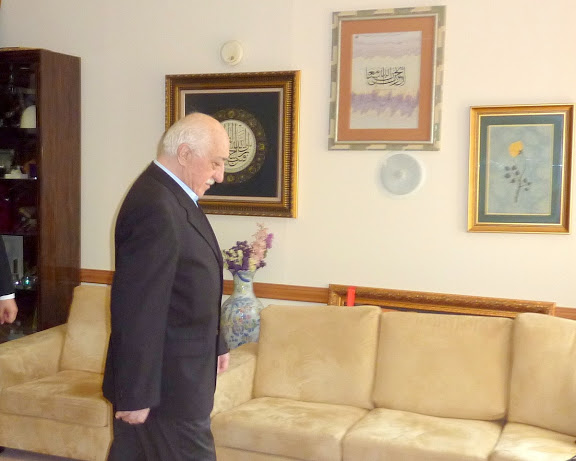
2014-03-07-fethullahgulen1.JPG
But, let us note that most of news coverage paints Gulen within a political narrative -- forgetting (or ignoring) four decades of civil society advocacy, education and dialogue activities and support for democracy and human rights. There is more to Gulen than this current political paradigm. Some history and perspective will help set the facts straight.
Gulen was raised in a very pious family in Eastern Turkey in traditional Sunni Islam while also being immersed in various sufi teachings. He was trained in the spiritual and religious sciences, both at home and under the tutelage of the region's religious and spiritual masters. He was very influenced by the sufi works of Rumi and Yunus Emre.
He was also introduced to Said Nursi's Risale-i Nur ("Treatise of Light") a collection of some 6000 pages on issues of faith and science and their interdependence. In one section Nursi's speaks of the three social ills in the Muslim world being ignorance, poverty and disunity, and the responsibility of all Muslims to overcome these. Gulen takes this social awareness one very important step further -- these three social issues are not Muslim specific, but affect all humanity, and that it is incumbent on all Muslims to help alleviate them no matter one's race, creed or color. These are the intellectual seeds for Gulen's "Service" Movement (Hizmet in Turkish).
During the late 1960s and 1970s, Gulen preached these ideals from the mosque pulpit to local coffee houses in Izmir, Turkey's third largest city, and garnered a following -- particularly among the local business people and, later, university students. His eloquence and oratory skills, his passion and tears-filled discourses, his love of country, love of God and Prophet Muhammed, love for humanity, his encouragement of service, and his desire to break the rigid mold of building mosque and madrassa initially led to a small fan base of supporters who volunteered and raised funds to support the first small dormitory and education center in the seventies. During his travels as a guest preacher, he became more well-known and popular throughout Anatolia. Similar projects begin outside of Izmir. During this time in 1979, supporters began publishing Sizinti (meaning a spring or fountain), a magazine dedicated to spiritual values and science. Throughtout the '80s, institutions start to increase in size and number. The first private college opens in Istanbul in 1986 -- the private Fatih High School.
During this time Zaman newspaper is purchased with an daily circulation of approximately 5000. Today, it is Turkey's most read newspaper with more than 1.2 million daily circulation. In 2007, an English daily, Today's Zaman started publication. With time various institutions were founded and multiplied, amongst them FEM prep schools, Fatih University, Kaynak Publishing Group, Samanyolu Television Group, Kimse Yokmu a relief and humanitarian aide organization now services more than 100 countries through various social service and community building projects and relief work. Dialogue and bringing together polarized communities was an essential element in Gulen's message and the first organization to bring together disparate sectors of society was the Journalists and Writers Foundation which brought together Turks and Kurds, the political left and right, Alevis and Sunnis, secular liberals and religious conservatives and Muslims and Non-Muslims. Tuskon, a national federation of various regional and provincial business networks, now has the largest membership in Turkey of any business organization with numerous international offices encouraging trade and cooperation.
All these institutions added to the Hizmet's mix of civil society initiatives -- all with those initial three social issues in mind. Numerous and various institutions supporting these shared values appeared throughout Turkey over these past four decades. In the early 1990s with the break up of the Soviet Union, Gulen encouraged business people to take up the challenges of Central Asia. Within a short time with the assistance of philanthropic business people investing in the region schools began to open. Similarly through business people's and university students' engagement with local diaspora groups, Gulen's ideas spread initially through Europe, Australia and North America and later Africa, Asia and South America.
The role model and positive activism of Hizmet participants were crucial in this process. As too was the example of institutions already flourishing and successful in Turkey. Gulen's articles, books, audio and video cassettes also played an important intellectual role.
Follow Emre Celik on Twitter: www.twitter.com/emrecelikrumi


Monday, March 3, 2014

AL JAZEERA op-ed: Hizmet unmasks 'undemocratic' Erdogan


As a prominent preacher, Fethullah Gulen has to express his opinion on politics, argues the author.
Last updated


Sevgi Akarcesme

Sevgi Akarcesme is a columnist for Zaman, the Turkish daily which has the highest circulation in the country and a correspondent and blogger for Today’s Zaman, an English daily in Turkey.

Trying to understand what has been going on in Turkey over the last couple of months is impossible without taking into account the corruption scandal that broke out on December 17, 2013. Yet an article which appeared on Al Jazeera succeeded in doing just that. It made no reference to the biggest graft probe that the country has ever seen.

On the contrary, as if to distract attention from the corruption probe, this op-ed placed the blame squarely on Islamic scholar Fethullah Gulen, claiming that he aims to control the state through his followers within the bureaucracy.

The Hizmet (Service) movement is a religious and social community inspired by the peaceful and progressive teachings of Gulen and encompasses a wide network of people not only in Turkey but also in 160 countries around the world.

It is true that Gulen is no simple preacher. Indeed, he encourages pious Turks to receive the best education possible, to go beyond the limits that the bureaucratic-authoritarian state has set for them and claim positions that were traditionally reserved for the elite. For this, he became the target of the Kemalist military, which views Gulen's movement a threat to the oppressive Turkish secular state.

Doctored tapes?

When the military launched a psychological warfare campaign to topple the Islamist government in Turkey on February 28, 1997, Gulen naturally faced the wrath of the soldiers and became a target. Some media outlets, which had been used as a "convenient tool" by the military, at the time, broadcast doctored tapes of Gulen to create the impression that his followers had "infiltrated" the state. Indeed, this was an argument that the aggressively oppressive secular state employed against religious citizens at large.

Listening Post - Turkey's media pressure points


It is therefore an ironic twist of fate that pious Muslims would resort to the same tools previously employed by the repressive military regime to undermine Gulen and his movement.

The recent op-ed referred to the same videotapes that were used by the military during the February 28 coup era.

Although Gulen was charged with an attempt to change the nature of the regime during the height of military pressure in 1999, he was acquitted of all charges in a trial that lasted eight years.

It is no secret that Gulen encourages the sympathisers of the Hizmet movement to not shy away from holding positions within the state. Every Turkish citizen, at least on paper, is equally eligible for government jobs as long as they possess the necessary qualifications.


Who's infiltrating?


But who can accuse a Turkish citizen of "infiltrating" his or her own state? Does the state belong only to a certain group or interest? Arguing that the Hizmet movement has infiltrated the state is the same as admitting that it was under the control of someone else.

There are people from all walks of life, from all segments of society, and from all age groups who support Gulen. Unsurprisingly, there may also be police officers and judges and prosecutors who approve of Gulen's interpretation of Islam.

However, in order to claim that their aim is to seize the state, one needs to bring forth concrete evidence that these people are taking instructions from Gulen or the Hizmet movement instead of their superiors within the bureaucracy.

The PM has been claiming that a "parallel state" within the state aims to topple his government, in reference to the Hizmet movement. Despite the illegitimate reshuffling of thousands of police officers and hundreds of judges and prosecutors, Erdogan's government has not been able to track down a single piece of evidence of a "parallel state".

In light of all signs of corruption, it has become evident that the whole parallel state argument is an imagined enemy that Erdogan uses in his fight against the "windmills".

Criticising Gulen for expressing opinions on issues other than religion is another Kemalist argument. The founders of the Republic of Turkey did not want religious people to be involved in politics or social issues. As the spiritual leader of a global movement that has activities in areas ranging mainly from education to the media, and from business to aid organisations, it is only normal for Gulen to express opinions on non-religious issues.

In advanced democracies, pressure groups are welcomed and civil society is encouraged to serve as a control mechanism within the system.

Anywhere in the world, spiritual leaders and their views are taken seriously due to their impact on the masses. In Gulen's case, it has been proven many times that he uses his influence in a constructive and positive manner, always asking people to act peacefully and within the boundaries of the law.

As for the unfortunate Mavi Marmara incident, in which nine innocent Turkish people were murdered by Israeli soldiers in international waters, Gulen did not "blame" the activists, as the article argued. He said that he would advise his followers to cooperate with the authorities, if the purpose was to bring aid to the Palestinians. Gulen also placed an advertisment, expressing his condolences and describing the victims as "martyrs".

Women who suffer from discrimination for wearing the headscarf in Turkey know well how displaying religiosity is a reason for being purged from state positions. Not only are pious Muslims forced to concel their identity by the repressive regime, but so are the Kurds, Alevis, and non-Muslims.

Ironically, today, it is the Justice and Development Party (AK Party) government, which had been oppressed in the past, that oppresses the followers of the Hizmet movement and openly discriminates against them.

What appears to be going on in Turkey now is a struggle between the Hizmet movement and Erdogan. However, when you scratch the surface, it is easy to detect the increasing authoritarian and arbitrary rule under Erdogan's government. All Gulen is doing is asking for a more democratic Turkey.

What changed is not the principles of the Hizmet movement, but the government's position, which succeeded to fool many with its democratic disguise until recently.

Sevgi Akarcesme is a columnist for Zaman, the Turkish daily which has the highest circulation in the country and a correspondent and blogger for Today's Zaman, an English daily in Turkey.


The views expressed in this article are the author's own and do not necessarily reflect Al Jazeera's editorial policy.


Source:
Al Jazeera


http://www.aljazeera.com/indepth/opinion/2014/03/hizmet-unmasks-undemocratic-erdo-20143113955830452.html