Rumi Forum's blog on Hizmet, Fethullah Gulen, peacebuilding, education and interfaith efforts.

Showing posts with label christian. Show all posts

Saturday, September 28, 2013

Fethullah Gulen Deplores Recent Attacks on Christians in Pakistan

September 27, 2013 – I am deeply saddened to learn about the bombing of a Christian church in Peshawar, Pakistan, which cost the lives 85 civilians and injured many others. I condemn this attack unequivocally and on this sad occasion reiterate my condemnation of all forms of terrorism regardless of perpetrators or their stated purposes.

Any form of attack, suppression or persecution of minorities is an act that contradicts the tradition of our Prophet upon whom be peace and blessings. Whether it is the senseless killings of innocent Christians in a Pakistan Church, the attacks on Coptic Christians in Egypt or the suppression of minority rights anywhere, Muslims should come out first in condemning these actions.

Every human being is created equal by God. Basic human rights, such as the right to life, to live in peace and to be treated with dignity, are sacred rights given by God. No suffering of Muslims can be used to justify inflicting suffering elsewhere on innocent civilians. In true Islamic thought ends never justify means.

I extend my heartfelt prayers to the injured, the families of the deceased and all of the people of Pakistan.

Read more of Fethullah Gulen’s statement.

Tuesday, July 23, 2013

Rabbi Dr. Lawrence Arthur Forman: The Importance of Multi-faith understanding and the dangers of religious intolerance


The below talk was present by Rabbi Dr. Lawrence Arthur Forman, William & Mary, Feb. 3, 2013
---------------------------------------------
D.Min, D.D., Rabbi Emeritus, Ohef Sholom Temple, Norfolk, VA
Founder, Institute for Jewish Studies and Interfaith Understanding, Old Dominion University, Norfolk
Intermittent Chaplain, Veteran’s Hospital, Hampton, Virginia


Leonardo daVinci, perhaps the most significant figure of the Italian Renaissance, told his disciples: “ the more you know of men and things, the more you love them. From great knowledge, great love springs. To know a man or a thing deeply, profoundly, inwardly, is to learn to love all human life.”

Today we know the truth of what Da Vinci taught his disciples: that knowledge of the “other” brings understanding and compassion, and that most hate springs from ignorance and fear.

Today, I want to share with you my understanding of the blossoming dialogue that is emerging here in the United States among the different faith groups, why it has been successful here, and what we each might do to foster its growth globally.

(Because of our time constraint I’m limiting my remarks to the Abrahamic faiths: Judaism, Christianity and Islam.)

Most of us are more familiar with Judaism and Christianity than we are with Islam. This afternoon, I would like to share a bit of my own experience with interfaith work among Christianity, Judaism and a particular facet of Islam, Turkish Islam.

In the late 1990s, after serving our community for some three decades, it became obvious to me that great accomplishments in the area of human rights and human services would in the future have to come from the impetus of our main-stream religions. In order for that to happen, I believed, that we in our respective Churches, Mosques and Synagogues, would not only have to study and know about our own faiths, but also, we would need to learn about the faiths and beliefs of our neighbors.


History has much to teach us. Allow me a few moments to catch us all up on a few key points.

Not all of the world’s religious systems have had a long-standing commitment to respecting the integrity, the worth and total value of every human being. That concept is a modern one. But neither did the ancient religions lack any manner of ethical life. They each have had some truth to speak to the world. Even the pagan world was not so morally corrupt that it was waiting only for a new revelation to teach it ethics and morality. Plato and Aristotle, Plotinus and Seneca, had molded the thought of the Mediterranean world long before Christianity or Islam appeared on the scene, and gave them exalted moral codes of living. But there is one thing which they did not do: their morality lacked a driving impulse; it was not dynamic. The Stoic, for example, who was a truly moral person, was content to be moral in and by himself, to lead a calm, disassociated life, and to perfect the self; he was concerned with self-culture and self-improvement. That there was evil in the world, that there was sin in the world, that there was slavery in the world, that there was poverty in the world, that other people were weak and did not have the strength that he possessed, that seemingly did not concern him. Christianity brought into that world the Jewish ideal of service, that the highest goal in life is not self-culture but human helpfulness. The Roman knew what it is to be a master, but did not know what it is to be a servant of humankind; and the Christian brought to him the Jewish message of the servant of God, that the highest type of person is not the masterful man, but the person who subjects himself, and works unceasingly for social justice and civil rights for all citizens, even for all humankind; to be a light unto the nations.

The ideals and virtues of humility, of meekness, of forgiveness, of mercy, kindness and love were not admired by the Romans. Those ideals came from Jerusalem. But it was through the channel of Christianity that these Judaic ideals entered into the world and became part of it. Christianity taught the Goths and Huns, the Franks and Saxons, the Visigoths and Teutons a new definition of civilization…that we are our brother’s keepers and we must take care of each other because we’re all we’ve got.

These were the ideals that first leaped from the lips of Isaiah and Jeremiah, from Amos and Micah, and they infused Islam through the influence, primarily of Christianity, but also through the impact of Jewish civilization on the desert Arab tribes. If our Bible today is translated into every living language and dialect, it is due primarily to Christianity. If the Jewish heroes, the spiritual giants, Abraham, Moses, Samuel, David, the Prophets—if they are known to the world, if they have become part of the speech and thought of mankind, it is due to Christianity, and if the basic Jewish ideal of the kingdom, the Messianic ideal, the hope that some day justice will flow over the world like a mighty stream, the hope that some day men will beat their swords into plowshares and spears into pruning hooks, the hope that some day each person may live under his vine and under his fig tree with none to make him afraid. The hope that some day all oppression will disappear, the hope that some day each child of God will inherit his divine patrimony…if that Messianic ideal is today the goal toward which civilized peoples are moving, then it is due, to a large measure, to the work of education and teaching which the Enlightenment carried into the world, and it is due to the liberalization of religion which has both its roots and fruition in our Democratic society, here in the United States of America.


Here in America there is the bright light of hope to promote the values we hold dear. Often we find that different faith traditions hold opposing views on important issues that affect not only the specific faith community, but because those values have implications that will necessarily affect others, they also spill out into the wider community. We might not all embrace those values and ideologies. Concepts of when life begins, the role of women in religious leadership, the origin of sacred texts and their authority within our lives, the appropriateness of dissention and diversity, the legitimacy of choice and the meaning of words like marriage and truth…these are but some of the realms where our religious traditions might find conflict. And yet, here in the U.S. we have seen time and time again, that for nearly all of us, the highest value we each hold in our diverse religious communities is discovering how to live in peace and harmony together – despite our differences. Yes, we all try to get our social agenda accomplished, but we do so in an environment of mutual respect. Even when we don’t agree with one another, most of us respect each other’s fundamental right to dissent.

Over the centuries, Judaism developed the concept of Pikuak Nefesh, that the saving of a life, takes precedence over all; This means not shedding blood over ideology; saving a life is the most crucial value. Thus, in Judaism, one can even violate the holy Sabbath, or any rite or ritual to rescue a person from harm. This means that if someone burns your sacred text, you don’t respond by destroying him; If someone denigrates your Prophet or Holy figure, you don’t shed his blood. If someone engages in a behavior that your religion finds abhorrent, you don’t resolve the matter by resorting to bloodshed. There is a line in Genesis, that all 3 Abrahamic faiths are predicated upon; and that is no matter how greatly we might be annoyed by our fellowman’s behavior, we are still our brother’s keeper, and we are responsible to ameliorate that behavior without resorting to the destruction of our brother.

It is primarily here in the United States where people have learned to differ peacefully and respectfully. People have come to understand that just as it is a sacred right of a human being to work toward shared values, so too is it a sacred right to protect our fundamental differences. And in this Democratic atmosphere of greater freedom and tolerance which has come to America, and through America is exported throughout the world, Judaism, Christianity and moderate Islam are becoming more courteous to one another.

There are today, people like ourselves, Muslims, Christians and Jews, who have inherent within them the post-enlightenment liberal spirit of Democracy, tolerance and understanding which has come into the world. It does not, of course, mean that Islam, Judaism and Christianity are becoming ONE. It does not mean that all our differences, are whitewashed. All three religions retain their distinctive coloring, their characteristic emphases, and all three are giving definitive direction to their faithful ones. But it does mean that these differences need not necessarily lead to hate and antagonism. By accepting these differences in the American spirit of Democracy, adherents of these three great faiths may yet, in a spirit of helpfulness, mutual cooperation and respect, work for common ideals, and the realization of those shared goals which benefit the common good.


The way to begin this process is precisely in forums such as this, among open-minded individuals, where presentations can be made to discuss the various possibilities to support and uphold those shared human values that can bring about healing, hope, happiness, prosperity and peace among these diverse faith groups.

For years, I have spoken in Churches and Temples about this interfaith idea. Everyone seemed to agree, but each individual Church and Synagogue, because of its primary purpose in advocating its own religious orientation, initially balked at putting the idea of an Inter-faith coalition as a primary agenda item.

But, the tragedy of 9-11 made this idea ever more relevant and crucial for our very survival as a freedom-loving nation based on Jeffersonian values and the principles of our Constitution.


I’ve worked in the interfaith community all my adult life. I have very dear and special friends in all of these religious systems. We have shared the microphone both on radio and television. But it was as faculty advisor to the Turkish-Muslim Better Understanding Club of Old Dominion University, that I learned of the broader ramifications of the Rumi Forum and Turkish Islam. In that advisory position I was invited to travel to Turkey to get a first hand experience of the excellent science and math schools being built in the Middle East and Africa by the Turkish Philanthropist, Philosopher and Scholar Fetullah Gulen, a man who continues to work for open dialogue and understanding among all races, religions and ethnicities.

With the direct assistance of individual supporters and ODU Presidents Jim Cook and Roseann Runte, we created the INSTITUTE FOR JEWISH STUDIES AND INTERFAITH UNDERSTANDING. The Institute was designed to coordinate lectures, symposia and reading groups related to Jewish history and thought, as well as continue our dialogue with Christian, Muslim, and Asian faith traditions. We believed that by presenting information about the world’s religious and ethnic diversity in a University setting, through open dialogue, we would have an ever deepening understanding of one another, and perhaps even be able to set aside some of our stereotypes and prejudices. Our target groups included the students enrolled in the University and individuals and groups from all religious denominations from the community at large. We visited a variety of Churches and Temples in Norfolk and Virginia Beach.

We learned that much of modern Turkish Islam is based on the philosophy and poetry of Mawlana Jalal al-Din al-Rumi, a 13th century Sufi Saint, and the 20th century scholar and philosopher, Fethullah Gulen.

An outspoken advocate of dialogue, Gulen writes: (and I quote)“(We are all surrounded ) by enemies. Given this, we cannot afford to argue among ourselves. Moreover, we must temporarily forget some focal points of controversy between Christian and Jewish spiritual leaders and us, and seek dialogue with them. The uncivilized may think they will accomplish something by hitting and fighting, while noble and enlightened spirits believe they will realize their goals by thinking and talking. I pray we have left the period of brutality far behind. Victory in civilization and acceptance of truth will be accomplished through persuasion, discussion, debate and dialogue….”(end quote)

The Rumi Forum, an organization in Washington, DC, based on Gulen’s teachings and principles, recognizes and acknowledges all of the great religions, Eastern and Western, which ask the eternal human questions and seek answers to these dilemmas: As Gulen asks (with us): “Where can we find purpose and meaning in our brief days on earth?” “How can we live more in touch with what is real?” “How can we continually renew our quest for freedom, social justice, democracy and peace in an often torn and struggling world?”

The Rumi Forum emphasizes that dialogue will infuse our ethical actions, that through dialogue we will long continue to celebrate each other, so that we might see the future as an opportunity to be transformed, and to make our world worthy of redemption.

So where then is our energy to be spent if we are to encourage such dialogue?

In the 12th and 13th centuries Islam flourished; it created science and poetry, literature and art. But because there was no concomitant development in the area of modern scientific Biblical (or Koranic) higher criticism, there was backsliding and regression. As long as people remain locked in a dogmatic, authoritarian, fundamentalist position, claiming that only they have the right and correct way to God and exclusive rights to “the keys to the kingdom of heaven”, then it is almost a vain effort to propose dialogue toward mutual understanding.


Gulen’s movement, based in the Secular Government of modern Turkey, is the nearest thing we have to anything that might be called: “Liberal Islam.” Just as the Bible and the Torah have been interpreted in a modern, analytical way, thus leading to the development of Liberal Judaism and Liberal Christianity, so too must Islam, if it is to further a partnership in our Post-modern world, develop a Liberal Islam, with modern reformist ideas, addressing gender equality, human authorship of sacred texts with its accompanying fallibility, and full complement of modern religious hermeneutics to remain the vital faith that resides within its great history?

The nearest thing to Liberal Islam today, are the schools of science, math and technology that are being built around the world by the Gulen movement. This is a shining example of modern Islam in action! There are glimmers of light because of the work of Fethullah Gulen and his disciples! For example, here in America there is a movement in Islam to reclaim “jihad” as an inner personal spiritual struggle, a self-imposed battle for personal improvement, a “jihad” of the heart! “Jihad” is not to be interpreted exclusively as a physical battle, but the term has been appropriated for this exclusive negative meaning by extremists and terrorists. The word “Jihad” literally just means to struggle - and like Jacob struggling with the Angel to find his best self and his place in the world, so each of us must struggle in our quest for the divine to find the meaning we so desperately seek.

It was only in our Democratic Country that Judaism and Christianity were able to integrate science and liberal thought into their religious systems. Just as the United States originally imported liberal Christianity and liberal Judaism from Germany, then reworked them over and over again, finally exporting American Liberal, reformist, progressive Christianity and American Reform Judaism back to Europe, Israel and other lands, so it is in America that we can best foster a more Liberal Islam; and building upon the Gulen movement, encourage that faith community to share its new-found sense of openness, and consequently perhaps even influence Islam around the world.

And so we are met at this forum, in dialogue and friendship, to reaffirm those core ethical values in our own respective faiths, and to grow toward a better understanding of one another; and as one loving family, come together with the reaffirmation to heal and repair this wonderful world of potential that God has given us.

The great 12th century Jewish philosopher, Judah Halevi, in his famous text, the “Kuzari”, speaking of Christianity and also of Islam, said: “These people, these religions, are the preparation for the Messianic day which is to come. Just as a seed must break up and separate into parts in order that it might absorb the fruits of the soil; the rain and the sun, so that it might become reintegrated later on in a fruit and a flower, true to itself and its nature, so Judaism had to separate, in a sense, disintegrate, into other faiths besides itself, so that it could absorb the strength of the whole of mankind for its own ultimate growth in the fulfillment of its destiny.”

Great and eternal is the debt that these great religions owe each other. Now it is up to us to learn and to teach, to understand and to share, to speak and to show by the example of how we are living our lives, that the grand humanistic teachings of these three ancient yet modern faiths can yet be carried out, so that together, we might tap the mind of the One God of us all, and see the future as an opportunity to be transformed, and to make our world worthy of redemption!


Thank you.


Wednesday, July 10, 2013

MEDIA: Mandela and Gulen by Ibrahim Ozdemir

Mandela and Gülen by İbrahim Özdemir *


Illustration, Cem Kızıltuğ


1 July 2013
(This story was written during the darkest days of the so-called Feb. 28 process and was published in the Zaman daily on Dec. 21, 1999. Today the whole world is focused on Nelson Mandela who has been in hospital for the last few days. I think it is time to rethink the message given by two great leaders of our time, Mandela and Fethullah Gülen, a decade ago at the Parliament of the World's Religions. We join in the prayers for Mandela and wish these two great leaders health and peace.)


The Parliament of the World's Religions held its largest and final meeting of the century on Dec. 1-8, 1999 in the South African city of Cape Town.


As is known, this parliament held its first meeting in Chicago in 1893. The second gathering was again held in Chicago a hundred years later. Approximately 8,000 people from various religions and beliefs participated in the latter event and accepted the Declaration of a Global Ethic.

Search for solutions to mankind's problems

This point made by Parliament President Dr. Howard Sulkin was very important: The 20th century was the stage of two World Wars and many smaller ones. Emphasizing that approximately 200 million people had lost their lives in these wars, he said: “The scientific and technological advances in the 20th century caused many problems, the environmental crisis in particular. For this reason, it can be seen that many people are turning once again to spiritual traditions and religion as they enter a new century. All religions and their members have a great responsibility to make the 21st century an age of peace, tolerance and love. As was clearly seen in Communist Russia, it's not possible to destroy religious belief by using violence and force. In addition, taking a lesson from religious wars in history, an opportunity should not be given to those who want to make the 21st century a stage for a war of civilizations. For this reason, we all have to take on great responsibility. Protecting our differences and taking strength from our spiritual traditions, we must find solutions to mankind's problems.”

New turning point


As a result, the meeting held at Cape Town was very important and it appears that this will be a new turning point for all religions. Just like UN decisions, all decisions made here will be announced to the world and those acting contrary to these or those infringing on them will be publicly criticized and exposed. The most important aspect of this meeting, in which more than 6,000 people from different religions participated, was the fact that it was held in a spirit of civil initiative.


This meeting carried a unique meaning and Cape Town was specially selected. South Africa is not only a country of people whose people are black, but at the same time it is a country where one of this century's darkest, most dictatorial, racist and oppressive regimes came to power. For many years people had been segregated into groups according to color, language, race and religion and were ruled by a white, racist regime that comprised only 13 percent of the population. When you take into account the fact that South Africa's hero Mandela spent 28 years in prison and that the country had turned into a prison, the nature of the oppressive regime can be better understood. In addition, people had been divided into three categories: whites, mulattos and local blacks. Non-whites being able to enter white residential areas and certain districts in the city was dependent on “permission.”

However, all this oppression and persecution didn't stand for long against man's belief, honor and human rights and freedoms. The end came in 1994 when Mandela was elected president. Thus the underlying spirit of the Parliament of the World's Religions gathering here was: It is not possible to eliminate man's rights and freedoms and religious beliefs by means of force, oppression, violence or terror. In addition, one of the basic goals of the meeting was a discussion of religions' contribution to man's peace, security and a sustainable world.

Mandela: My belief kept me going


Participating in the meeting, Mandela made some very interesting points about the power of religion. Mandela is known by the slogan, “The Struggle Is My Life” and he endured unthinkable kinds and amounts of torture. “If I didn't have religious belief, I could not have endured oppression and torture. My faith was the basic motivation of my spirit of struggle. In other words, if I'm addressing you here today, it's a result of my religious faith and God's grace. Without this kind of faith it wouldn't be possible to withstand this kind of inhumane torture. As a result, many of my friends met ruin because they didn't have such faith,” he said. Concerning the role of religions, Mandela said: “While we were in prison, our connections with the outside world were cut. However, Muslim, Christian and Jewish religious people and groups didn't leave us all alone. With their help, we left prison as educated people. For this reason, in order for the 21st century to be a time of peace and not confrontation, great duties and responsibilities face religious people. In this respect, the significance of this parliament is even greater.”

Hocaefendi, Mandela and Dalai Lama


Everyone gave these views a standing ovation. Like Mandela, world-famous Tibetan monk the Dalai Lama was another leader who attracted a lot of attention. He was the center of attention, especially for Western youth and other groups. Pointing out the mission that awaits religions in the new millennium, the Dalai Lama emphasized the importance of dialogue among different faiths and civilizations. Even though he didn't attend the meeting, Fethullah Gülen Hocaefendi was another person who attracted attention with the message and presentations he sent in his stead. Hocaefendi was personally invited to the parliament, but he was unable to attend due to poor health. In spite of this, he sent a message of greetings and two presentations. In my opinion, this shows the importance and support Hocaefendi gave to the meeting, on the one hand, and to efforts for peace and tolerance among religions and civilizations on the other. Because of this, both the message and presentations were received with great interest. The West knows him not only for his wisdom and educational efforts, but also for his initiatives to build “Peace and Dialogue” on the foundations of love, mercy, accepting everyone as they are, mutual respect, human rights and justice. The image of his being received as a Muslim scholar by the Pope at the Vatican is preserved in Westerners' memories. The interest in him shown by international communities is interesting in light of the fact that despite all these constructive efforts, some people in Turkey persist in not recognizing Hocaefendi or in misinterpreting his message. For this reason, I believe it's necessary to underscore some of the points in Hocaefendi's presentations.


The first point Fethullah Hoca made regarding the parliament was the meaning the 21st century has for all religions. “Every new dawn, every new day, every spring, every new century and millennium in human history means a new beginning and new hope. In this respect, within the wheel of time that turns regardless of our will, man has always sought a new breath in the freshness of the dawn and a new breath of life, especially in moments of difficulty, and with the ease of stepping out of the cradle, he felt hope and desire to step out of the darkness and into the light.


It can only be estimated how much time has passed since our first ancestors walked on this earth, which is mentioned together with the vast skies in the Quran and held as their equal in respect to its divine artistry and ontological meaning. It appears that it will always be only an estimate on man's part. However, according to the calendar we use to measure time since Jesus' (p.b.u.h.) birth, we are at the threshold of the third millennium. Actually, just as time is perceived by the individual's perspective, the dimension in which he exists, according to its position in the universe, it turns in spiral relativity as well. For this reason, because of its meaning and date and social value, which is going from one condition to another, from tribalism to civilization, from belief to action, from the individual to society, the Hijra was accepted as the beginning of Islam's calendar. Along with this, time measurement has gained an international character, and the world is at the threshold of a new millennium. At this point it is beneficial to mention that there is a situation of relativity here. It is a point to consider that in the history of man, just as a century is measured as 100 years, an average lifespan of 60 years could be considered a century as well. Approaching the matter from this angle, we are already in the fourth millennium A.D. and the third millennium A.H. On the other hand, using the measurement of 100 years as a century, we are already in the eighth millennium according to the Judaic calendar. In the Hindu historical line we are living in the “Kali Yuga” period. I especially wanted to mention this issue in view of the fact that frightening events that are expected in the third millennium by the Western world have already begun to have their effect on people's spirits.”


In the following text, Hocaefendi emphasizes the importance of faith and belief, which were underscored in the previously mentioned words of Mandela, “I wouldn't be here today if it weren't for my religious faith.”


“Man always lives with hope; he is the child of hope. When hope is extinguished, his life is finished, even if it continues physically. Hope is in direct proportion to faith. Just as the winter season comprises one-fourth of the year, the periods similar to winter in an individual or society's life are always less. The wheel of divine activity is so magnificent; Divine Unity, which surrounds all of existence and individual existence at the same time, turns with the wisdom of change. Just as each day the revolution of night and day constantly gives hope to man and life to his spirit, every year the purity of spring, the maturity of summer and the austerity of fall lead us to say ‘hello' to winter. Similarly, in the full wheel of life, whether on the basis of individuals, nations or all mankind, the expectations of dawn, spring and summer make us smile at the winter snow. This wisdom-filled ‘period of Allah' revolution is a vehicle for contemplation, insight and gratefulness rather than fear and pessimism for those who possess faith, foresight and the sensitivity to feel the truth, or, in other words, people whose hearts are clear and whose ears are open. Just as day develops in the bosom of night and just as winter serves as the womb of spring, in this evolution life becomes clarified, matures and gives the expected fruit. Within this evolution, the aptitudes latent in man become skills; like rose petals opening, knowledge weaves technology on the loom of time and, parallel to the advancement of time, mankind draws closer, step by step, to the result that is destined for it.”


At this meeting attended by members of all the world's major religions and where discussions were held on what religion could contribute to resolving the problems facing mankind in the 21st century, Hocaefendi summarized what was required as follows: “It is necessary to neither close our eyes to reality nor to leave it as it is. Man mirrors all of Allah's attributes and names and he has the honor of being the means for the task of construction on this Earth in His name and he has the responsibilities this entails. If he doesn't see the wisdom in events which are absolute good in respect to creation and the Creator, but contain evil in some aspects respective to man, then he cannot be saved from the despair and pessimism that man usually falls into, like the existentialists who expressed themselves in the most spectacular way of the century. Thus, life becomes a meaningless process; existence is an emptiness without substance; nonsense is the only criterion; suicide has value and death is the only inevitable truth. In this respect, in the awareness and acceptance that one spoke of the wheel that moves history forward is tied to man, it is necessary to see and pinpoint the realities of life and mankind. On the other hand, it is necessary to give direction to these realities in line with the purpose and ideals based on that which has existed since the first day without changing and which will continue to exist in the foundation of universal values based on faith. This is a necessity of being a man and the only way to sustain life within an orbit of hope, love, excitement, enthusiasm and joy.”

Hocaefendi described the meaning and importance of inter-faith dialogue and tolerance for mankind as follows:

“I hope and believe that the new millennium, contrary to what the West fears, will promise at least a happier, more just and more merciful world than the previous one. Although Islam, Christianity and Judaism come from the same root, possess the same basic principles and are fed from the same source, they have existed for centuries as rival religions. Now, we witness that efforts for dialogue among these religions, efforts that extend to even the ancient Hindu and Chinese religions, are having positive results. As was briefly mentioned previously, in a world that has become a global village, this dialogue will develop as a necessary process and members of the great religions mentioned will inevitably draw closer to one another and find ways to help one another.”


Pointing out that even the conflict between religion and science has lost its attraction and that a more compatible atmosphere has developed between them, Hocaefendi underscored the important role of the Risale-i Nur in this as follows:


“The word of God, which is a ladder of light taking man to God, is manifested in historical form in the Qur'an and the Old and New Testaments. Nature and, on the micro plane, man are manifestations of the will and might of God. Thus, there can be no real conflict between religion and science which examines nature and man. However, previous centuries have painfully witnessed that science has led to a positivist and materialist denial of religion. Christianity has been most affected by this. Efforts made on this issue whether by Christian theologians and scientists or by Muslims, especially the book, Risale-i Nur, taking up this subject in a wonderful way, have enabled this conflict to be resolved. I am hopeful that this centuries-old conflict between religion and science will come to an end, or at least that the futility of such a conflict will be verified.”


As can be seen, a culture of peace, tolerance, acceptance of differences and living together in harmony has met wide acceptance all over the world. In spite of those who see their interests and gains in conflict, genocide and war, mankind wants to enter the new millennium in peace, harmony and justice. It is suggested that national funds spent on arms, conflict and war be spent in the solution of problems that affect us all, especially education, health, poverty and the environment. The most joyful point is that people and groups of different religions and beliefs are showing the will to work together and cooperate on these issues. There is no reason not to hope that the coming century will be better than the previous one.


Monday, December 10, 2012

Evangelical Christian Pastor on Gulen: "gained a profound respect for his ability to balance strong conviction with a desire to promote peace among all people"

Speech to the Maryland Turkish American Inhabitants + Rumi Forum
“Peace through Education and Dialogue”
Thursday, November 29, 2012, Pikesville Hilton Hotel, Baltimore
Joel O. Rainey, Ph.D.


It is truly a pleasure to be standing in front of you tonight, and to share some recent experiences that our group of pastors had in the Republic of Turkey with our new friends.  And tonight, I think it is very important that I be clear how much I mean that.

An interfaith dinner is a strange place to find an Evangelical Christian.  For anyone in the room who follows professional football, it’s a little like finding a Steelers fan at M&T Bank Stadium wearing purple, but I am brave enough to stand in this room and admit that I am, and, I have. So I am very accustomed to being in places you wouldn’t expect me to be.

But I do stand here as an evangelical Christian, who leads a network of more than 60 evangelical churches, and typically, we just aren’t the sort to be found at events like this.  And I think my presence speaks well of our Turkish friends, and their high capacity for developing unlikely relationships. They have modeled for me what it means for two people of very different faiths to walk together, and I am very grateful to them for their example, and for their friendship.

It was through our new friends that I first heard the name
Fethullah Gulen.  The trip I and our pastors took two months ago was largely for the purpose of seeing with our own eyes how Mr. Gulen’s influence is shaping not only Turkey, but the wider Muslim world for the better, and so my curiosity was raised even more about this man.  Who is he?  And why would he want those who follow his example to reach out to people like me?   

I spent a good deal of time reading
Gulen’s writings, and I was particularly interested in his theology.  After all, I am a pastor and those tend to be the circles in which I walk.  And what I discovered is that from the perspective of belief, Fethullah Gulen is very much an “old school” Sunni Muslim preacher.  Many of his writings aggressively defend the Koran as the written Word of God.  I discovered a man who is serious about his own faith, and who believes deeply and profoundly in the following words from the Koran; “Say he is Allah, the one and only.  Allah, the eternal, absolute.  He begets not, nor is He begotten.” [Surah 112]  And initially, I found it strange that a man who believes such things would want to reach out to me.  I serve a network of churches that believes God not only had a Son, but that the ultimate way in which He has demonstrated His love for the world—including everyone in this room--is by giving that Son to die and bear the wrath of God as our substitute so that we can be redeemed.  But as I continued to research Mr. Gulen, I discovered a man who is anxious to reach out to people of other faiths, regardless of significant differences, and I have gained a profound respect for his ability to balance strong conviction with a desire to promote peace among all people.

I love this quote from his book Toward a Global Civilization of Love and Tolerance, “With the blessings and beneficence of God, we are going to do our best to help this breeze of tolerance and dialogue to continue blowing.” Among those who have answered Gulen’s call to this vision are those who host us tonight, and they are people who I am honored to call friends.  

These friends recently hosted a group of our pastors for a nine day visit to Turkey, and because of their hospitality, we were able to witness first-hand the good that is being done by our friends in this part of the world.  We saw things transpiring in that part of the world that I honestly have never read about in the Baltimore Sun, or seen on CNN.  I understand that it takes bad news to sell papers and increase Nielsen ratings, but the good things we witnessed there stand in great contrast to how most Americans perceive the so-called “Muslim world.”  

Among the great things we saw were Gulen-inspired institutions of higher learning.  In Konya, home of the 13th century philosopher Rumi, we visited Mevlana University, where students from all over the world come to study education, law, medicine, engineering and business.   In Sanliurfa, less than 30 miles from the violence that has recently occurred across the Syrian border, our pastors and I spent the day in a place where Turkish, Arabs, Kurdish, Jews and Christians have lived in peace for 1000 years.  One young pharmacist who lives there and is part of this movement told me “I want to take what we have done in this city, and spread peace across the border and throughout this part of the world.  I want my city to be the starting gate for peace!”  I love his heart, and I’m hopeful for a world where that heart is shared by all of us.

It was Istanbul where our pastors were introduced to an organization called Kimse Yok Mu, a non-profit disaster relief organization that since its inception in 2002 has brought help and relief to more than 60 countries.  We were also introduced to the good people at the Journalists and Writers Foundation, an organization that provides six very distinct platforms for dialogue and the promotion of peace among adherents to the world’s religions.

One of the most impressive things we learned about was their food.  I’m more than just an evangelical Christian, I’m also a Baptist, and we Baptists place a high value on food!  And theirs was amazing!  I have never tasted better lamb, and ever since returning to the states I’ve been on a seemingly hopeless search for mirash, which is a form of ice cream that has left me completely dissatisfied with what my local grocery store offers.  And of course, there is the baklava, which makes me believe our Turkish friends have stumbled onto the recipe for the manna that God provided Moses and his followers in the Egyptian wilderness.  It was exquisite!

Of course, the real benefit of a meal is the opportunity to get to know those with whom you are dining.  My primary role in my work is to be  a mobilizer of churches for intercultural work here in the Baltimore-Washington region, and around the world.  This means that I’ve had the opportunity to be in the company of people from almost every nation and tribe.  But I can tell you that when it comes to hospitality and graciousness, my Turkish friends cannot be matched!  By hosting us in their home country, they have given us an incredible gift, and an experience that I think has changed all of us for the better.  As I reflect on what we have learned from each other thus far, there are some lessons that my friends taught me on this trip that I want to share with you tonight.

The first lesson is this; the movement we witnessed in Turkey, while appearing on the surface to be a “young man’s movement,” embodies the power of cross-generational effort.  Many young people have responded to Fethullah Gulen’s call to service, but while in Turkey we also observed older generations responding to that young passion for world-change with financial support, and other resources necessary to accomplish their goals.  It was not uncommon for us to see this kind of cooperation carried out by three or four generations of Turkish people, all of whom were committed to these goals of peace and prosperity for their nation.

Second, these are people who speak quickly, boldly, and loudly to the violent elements of their faith, and in doing so, they teach all of us to speak against the violent tendencies within our own spheres of influence.  Our group landed in Istanbul less than a week after the attacks on the U.S. Embassy in Benghazi, and our friends were quick to condemn the violence.  And as we have discussed this and other issues, I have discovered that our friends genuinely abhor violence committed in the name of their faith.  It is their strong opposition to these elements that has challenged this Christian to examine my own responses to violence that is sometimes committed in the name of Jesus.

When most of what we see of Islam in the media consists of images like masked men shooting a young girl for no more than simply wanting an education, the temptation is to see such violence as inherent in Islam itself.  But when we look at a picture like that and simply conclude “That is Islam,” we are too quickly forgetting that extremists of every sort and kind often appeal to their faith of origin as a source of authority.  I am a native southerner, and have examples of such violence in my own family tree: individuals who also intimidated minorities and the weak, and did so while hiding behind a white mask, and with a burning cross in the background.  As a follower of Jesus, I’m thankful that no one pointed at that picture and said “There is Christianity!”  And I’m grateful to be in agreement with Muslim friends who believe with me that neither of our religions should be defined by the cowards among us who would commit such atrocity, nor should we tolerate those within our own ranks who seek to do harm to others created in God’s own image and likeness.

Third, the dialogue they advocate is the very kind of “public square” discourse that makes for a healthy society.  As Americans, we rightly resist what Evangelical social critic Os Guiness calls a “sacred square,” wherein our social standards and body of law are based on one specific religion.  In a pluralistic and democratic society, the sacred square is impossible to maintain peacefully.  But while we are wise to resist “theocracy” as more progressive pundits have called it, neither can we have what Guiness calls a “naked square.”  Somehow, many of us in the U.S. have developed the idea that religious conviction isn’t just personal, but private, and therefore should not be an appropriate subject of national discussion.  The problem with that assumption is that faith touches the deepest and most meaningful part of who we are as human beings.  From a personal perspective, my relationship with Jesus Christ isn’t limited to what I do on Sunday.  It defines the totality of who I am, so if I can’t talk to you about my faith, you can’t really get to know me. Similarly, if a person sincere in any faith isn’t allowed to share that faith because of perceived cultural taboo, we never get to truly know and understand each other.  

While abroad, I experienced people who are quick to speak of their faith in God, who are willing to hear about our faith, and wrestle with us through the implications of our differences in a way that is respectful of each other.  This is the kind of atmosphere that illustrates well what Christian social observers call a “civil public square,” and in an ironic way, I was delighted to find its full expression in a nation whose predominant religious affiliation is Islam.  If done with respect for the image of God stamped on all of us, talking about our differences, and even urging each other to consider the truth of our respective faiths out of concern for each other can build a strong, healthy relationship of the sort we need so badly in our own country. After our visit, I’m convinced that our Turkish friends are highly qualified by their own experience to teach us how to have precisely this kind of conversation.  

Our group learned much while abroad with our new friends, and we look forward to learning even more as we continue to walk together.  We look forward to engaging with them in matters of common interest, and to building the sort of genuine friendship that demonstrates our common humanity in powerful ways.  If invited by these precious people to visit their country with them, I urge you to accept the invitation.  Clear your calendar and go!   And when you do, be prepared for the world to open to you in ways you may not have thought possible.  I’d like to thank my friends at MARTI for allowing me to share our experiences, and thanks to all of you for being here tonight.  


SOURCE: 
http://joelrainey.blogspot.com/2012/11/truth-in-dialogue-model-for-evangelical.html

Saturday, October 6, 2012

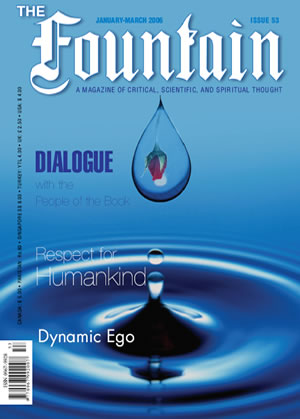
FETHULLAH GULEN: Respect For Humankind


M. Fethullah Gulen

Loving and respecting humanity merely because they are human is an expression of respect for the Almighty Creator. The other side of the coin, loving and showing respect to only those who think the same as one thinks, is nothing but egotism and self-worship. More than this, it is irreverent and self-conceited behavior to hurt the feelings of others who may not think exactly as we think, but who still are on the same main road with us in their thoughts and visions.

We dream of a generation who will embrace and build the future upon interpreting problems not according to the sources or reasons from which they arise, but with respect to their ideals. If we are passengers who are on different paths and using different strategies, but all heading for the same destination, then why should we defame the others who are with us on this sacred journey that has such a lofty goal?

The circumstances that will shape humanity in the future, in particular current world affairs, are forcing us to act with utmost care and alertness; in fact, they are forcing us to do so to such an extent that any decision hastily taken for temporary measures will result in errors that have no compensation. The architects of the future are obliged to build their world on the foundations of what human love and respect stand for and what they appear to be.

With its many dimensions, the modern world has pushed humanity into many dark alleys. And we have come face to face with many problems, the nature of which we have no idea. We are trying to cope with these problems, but they are extremely slippery and inconsistent, and in due proportion the outcomes are full of contradictions. There are thousands of Khidrs who are committed to fetch the water of life from Mount Qaf for humanity, but none of them possess any sign of the elixir of immortality. Despite all the efforts of these people who are “apostles-to-be,” respect for the human soul has been severely challenged by real dangers.

We have struggled for many years in this way; nevertheless, we have not accomplished any synthesis that will constitute the pillars of tomorrow. This has indeed been impossible. Our feelings and thoughts have promised and brought about discrete things, and we were like musicians with a broken record and an incomplete composition, swaying from one door to another, looking for a producer. When every individual denies all the other truths because of the portion of truth which they hold in their hands, and when they compel others to stick to their respective portions, will it ever be possible to have ideas line up one after another, to attain new syntheses, or to discover remedies that save? Can this ever be possible while some are harassing others with accusations of unbelief and sinning, or even physically assaulting them? 

The present situation that we have reached today is very dramatic and thought-provoking. Those who walked side-by-side in the past are strangers to one another today. The truths and untruths have been shifted, in accordance with group preferences, from their foundational pillars to rest on slippery rails. Under such chaotic conditions, it is impossible to discern either the loftiness of the goal or the differences of the means to attain it.

Humanity today appears to have become fixated on a single flower alone, although they had set out to enjoy the spring. They have lost all their hopes for reaching the goal that is on this path; the means to do so are what they have been fighting for. Their efforts and actions are merely to engage in effort and action. Just like a guide who has forgotten the responsibility of serving the temple and their servanthood to God, who is absorbed by trying to entertain the visiting tourists, so too have those who devoted themselves to a clique or a party today become foreign and indifferent to the ideal and the goal.

The humanity of our time has been imprisoned by focusing on one flower on the way to the spring, and has been deceived by a drop while chasing the ocean. I feel that such slavery will be impossible to overcome until we have liberated humanity and given them a new outlook. We are burdened with the task of expressing the truth . . I wish that we had been able to have done so!

No matter how charming and enchanting the atmosphere that catches the eye or fills the heart is there is no permission for us to forget the truth to which we are committed. We cannot stay alien toward each other while we are in the same camp. We do not have a monopoly of the good and the beautiful; therefore we cannot be allowed to wage a war with the passengers who are heading to the same destination but on a different path.

We may have some criticisms about the path and system of someone who thinks differently from us; this is an expression of minds that operate in different ways. But, if we are striving to reach the same horizon, we must at least respect the way others think. This is a prerequisite of heading in the same direction, sharing the same belief, utilizing the same terminology, and finally and above all, of respecting the sacred meaning glorified by God Almighty.

Let us be respectful to humankind! Let us respect the exalted truths they possess. Let us love them because of their Almighty Creator. If we can raise a community upon this perspective, people will eventually recover and they will manage to compensate for whatever they have lost.

The Fountain  - Issue 53 / January - March 2006

SOURCE:  
http://www.fountainmagazine.com/Issue/detail/Respect-For-Humankind

Sunday, April 22, 2012

WASHINGTON TIMES Interview: M. Akyol on Fethullah Gulen


Luke Montgomery interviews Mustafa Akyol about his new book "Islam without extremes - A Muslim Case for Liberty" . It seems many Western media outlets seem stuck, like a broken record, on Fethullah Gulen's so-called involvement in journalists' arrest. Mustafa Akyol is a seasoned and experienced analyst and commentator on Turkish issues. More info on Mustafa Akyol can be found here

Luke Montgomery:
 Last year, Turkish journalist Ahmet Şık wrote a book entitled You Touch, You Burn (Dokunan Yanar) targeting the Gülen movement. Before the book was even published, he was arrested and thrown in jail. What happened to moderate and tolerant Islam in this case? 
Mustafa Akyol: First, I have opposed the arrest of Ahmet Şık and similar journalists from the very beginning. I’m so glad that they are free now after being imprisoned for a year. This incident shows that the Turkish legal system is still very authoritarian and illiberal when it comes to freedom of speech. 
But, I would not go as far as to say that this illiberal episode in the Turkish legal system is a product of Islam. I don’t think it has any direct connection with the Turkish understanding of Islam. It was not the Islamic law or any Islamic interpretation which led to the arrest of those journalists. It was Turkey's illiberal anti-terrorism laws which define a terrorist organization very vaguely. 
These journalists were accused of being in an organization with some radical generals who wanted to conduct a coup. Now, I think that accusation was overblown, but at the end of the day that was the reason they were arrested. Yes, they had criticized the Gülen movement, but I don't think that was the reason they were arrested.
There are other journalists, very secular journalists who have denounced Fethullah Gülen and his movement, defined him as a CIA agent or a secret Christian, all sorts of things, but they have never been imprisoned. (highlights by RF blog)

Tuesday, March 1, 2011

BOOK REVIEW - Faith, Theology and Service in Peacebuilding

Stanley Ridge*

Fethullah Gülen's work and thinking starts and ends in faith. In a world that commonly extends conflict by speaking of religion either in stereotyped or in ideologized terms, this is a refreshingly engaged perspective.

Faced with the challenge of mounting hostility between the Islamic world and the West, and with belligerent and increasingly fundamentalist groups on both sides supposedly speaking in the name of religion, the need for peacebuilding with integrity is pressing. The writers of different traditions whose essays resonate here explore the faith-based ideas of one of this century's seminal thinkers and tease out their implications and potential for peacebuilding.


Gülen
is deeply and unequivocally Islamic. The first three chapters of the book, by the editors and Mohammed Abu-Nimer, introduce his approach to peacebuilding. They analyze his ideas through various modern lenses as within a tradition from Rumi, Al Ghazali, and Said Nursi, while also showing that the specific approaches he takes to peacebuilding arise from a thorough reading of the contemporary globalized world. Because these approaches are predicated on faith, the initiatives are heuristic. The movement into a caring engagement with the world is a movement of faith, marked by openness to discovery and so by an expectation of change. The object is not simply to change others, but to be changed with others, and so to move into and discover more of the just and caring social condition desired by Allah.

Part 2 takes a closer look at Gülen's reading of the globalized world and his deliberate transgression of the kinds of borders which are a product of modernism and fail to meet human realities or to orient us to global perspectives. In a fascinating essay, Klas Grinell bringsGülen's thinking into association with wider, postmodern debates. Borders, he points out, are associated with fixed identities which do not accord with our realities "in the multi-layered present" (68). Accordingly, crossing the border into the territory of the "other" perhaps does not characterize Gülen's aspiration because it seems to accept existing stereotypes and fails to leave room for the large areas of overlapping territory. Grinell changes the metaphor, seeing Gülenrather as on the border in the sense proposed by the Argentinian Mignolo:

Border thinking ... is thinking and knowledge produced from the borders of colonial modernity, knowledge that recognizes the colonizing aspects of what has been seen as true knowledge in mainstream modernity, and uses local resources to confront and alter that knowledge in order to know the particularities of life lived in that setting better. (75)

Irina Vainovski-Mihai pursues some of the implications of dialogue, which requires an open awareness of the other. She concludes that "the dialogical approach may transform the experience of the other into an experience of the self" (96). As Karina Korostelina suggests, though, that self embodies the creative tension in a dual identity, between "one component connected to a religious identity and another component that reflects membership in a secular nation" (104). The borders involved are different and shifting, finding resolution in a much more sophisticated and tolerant sense of the self. That, taken with Gülen's view of globalization outlined by Richard Penaskovic as more than economic and ideological, as referring "to connectivity and interdependence in all areas of life: cultural, ecological, economic, political, religious, social, and technological" (126), makes hostility manifestly problematic and is conducive to peace.

The third part of the book examines Gülen's theology of dialogue in comparative perspective. Turan Kayaoglu's informative essay traces the overlapping theologies of Rabbi Jonathan Sacks, Pope John-Paul II and Fethullah Gülen - theologies which place interfaith dialogue in the context of the core concerns of each faith. The theological leadership of these three major figures "validates, accommodates, and humanizes the 'other' in order to open up religious space for interfaith activities and to establish religious grounds to complement humanity's quest for peace, tolerance, and care for God's creation" (166). Zeki Saritoprak shows the continuity between Gülen and Ibn Khaldun, the fourteenth century Muslim sociologist, who emphasizes asabiyya or a non-racist, non-nationalist "group solidarity" around key transformative values. Forgiveness, love and compassion are values at the heart of all major religions and are essential to our full humanity. However, in the heat of social tension, they tend to provoke persecution which has to be faced with a patience that involves being true to the self one has discovered through faith. Despite the legal and spiritual persecution and exile Gülen has faced, he concludes "We are going to respect our character... As a believer, I promise that I will never shun any person, and I will not persecute those who have transgressed against me" (184). Approaching the topic from another angle, Douglas Pratt examines the historical "baggage" in Muslim-Jewish-Christian relations and some of the ways in which Gülen seeks to surmount it. I would have welcomed more attention to the persistent discursive patterns that mark that history. However, central to the notion of dialogue is acceptance that the supreme greatness of God cannot be captured in words and that truth blossoms and its implications become clear in an ongoing process of awed interpretation. For People of the Book, "The 'book' is ever a text requiring interpretive understanding and application" (203). Felicitously, the final chapter in this section has a strong emphasis on the hermeneutic. David B Capes places the thinking of the American Baptist, A J Conyers in dialogue with Gülen. Conyers critiques "the modern, secular doctrine of tolerance" in attempting to reclaim "the practice of Christian tolerance based upon humility, hospitality and . . . the incarnation" (207). At the same time, he explicitly recognizes the affinities between Christians and those of other faiths, including specifically "the Sufi mystics of Islam," in this practice (not doctrine) of tolerance (209). Capes concludes with the observation that whileGülen is specific about forgiveness, there seems to be no explicit discussion of it in Conyers. Of course, Gülen's "the road to forgiveness passes through the act of forgiving" (221) is strikingly resonant with "forgive us our sins as we forgive those who sin against us" in the Lord's Prayer. Capes concludes that the difference in the contexts in which the two theologians worked accounts for this apparent gap, implicitly emphasizing the need to interpret contextually.

Part four looks at the practice arising from this rich understanding of Islam. The five sets of initiatives discussed are a sample of the hundreds of innovative Gülen Movement ventures undertaken worldwide. All are undertaken by volunteers who seek to serve in lands or regions faced with conflict and very difficult social adjustment. In Gülen's words, "Holy people" carry the "new atmosphere, new understandings and dialogue" around the world, creating "islands of peace for stability and harmony" (181). What is most remarkable to me is the humility and rigor with which the volunteers "read" the local situation to determine how best to engage with it.

Modern Cambodia, recovering from more than two decades of traumatic instability, is a striking example. The situation of the minority Cham Muslim group, impoverished, hostile to public education as assimilatory, with religious education usually separated from life needs, and a high level of illiteracy in Khmer, complicates recovery. Philipp Bruckmayr shows Gülen Movement participants supporting Cambodian NGOs which promote "the acquisition of secular knowledge" within the context of faith, and offer practical support to the Chams (234f). The emphasis on "common values rather than differences" is reflected in translation of seminal works on Islam and in cooperation and dialogue with Buddhists (235). More characteristically Gülenian is the Zaman International School of Phnom Penh, which offers excellent secular schooling within a spiritually sensitive context, and has no assimilationist motives (245).

Jonathan Lacey discusses the Turkish Irish Educational and Cultural Society, a Gülenian group in a country with a tiny, fragmented and fractious Islamic minority. It emphasizes dialogue, supports conferences, and shows hospitality in annual iftar dinners during Ramadan, but most strikingly its members accept full, responsible citizenship: "[T]hey have no intention of assimilating, but instead intend to integrate" (263). It is a vital distinction.

The importance of civil society is emphasized by Mehmet Kalyoncu. He looks at the ways in which Turks, Kurds, Arabs and Assyrian Christians have been mobilized by the Gülen Movement in Mardin "to cooperate in tackling their common problems" (275). The Gülenian school there is also a community focus, and helps build civil society organizations. The focus shifts to initiatives in Kenya and the Philippines, again based on schools which bring together the children of parties in conflict, and provide a platform for addressing local needs.

The role of the Gülen Movement in predominantly Muslim South East Asian societies where there is strong sectarianism and a divisive politicization of religion is explored by Mohamed Nawab bin Mohamed Osman. The fact that the volunteers are driven by a sense of duty to serve in places in great need underlines the appropriateness of the Turkish name of the Movement: hizmet or "service to humanity." The service in Singapore and Indonesia involves dialogue and education with a strong emphasis on honoring and using local customs, as in the Halalbihalal ceremony in Indonesia to bring conflicted groups together in an atmosphere of trust and hospitality.

The final essay by Harun Akyol puts the Movement's credentials to the acid test in the multiple conflict zone of northern Iraq. Fifteen successful schools and a university have been established to provide a base for thinking and interacting differently.

This book, bringing together key papers from three conferences, offers refreshingly varied, critically nuanced views of Gülen's thinking and shows the profound impact hizmet has had on particular individuals and societies.

* Emeritus Professor of English and retired Pro-Vice-Chancellor of the University of the Western Cape, South Africa.

Published on The Fountain Magazine, January-February 2011 issue

See also:
And Rumi Forum sites:

Friday, November 19, 2010

MEDIA - Ukrainian Newspaper 'The Day' features article on Fethullah Gulen

An interesting article has appeared in the Ukrainian paper 'The Day' that details the important role Fethullah Gulen (Honorary President, Rumi Forum) has played in bringing together communities and educating a new generation of socially responsible people. Some quotes from the article appear below.

Link to full article is at the end.


Are we to wait for our Fethullah Gulen?   /ДЕНЬ/


By Serhii LASHCHENKO

.....“Gulen is a spiritual personality,” states Shokalo with admiration. “His heartfulness and cordiality became the motive for the growth of his incredible ability to communicate! He became the pioneer of wide-ranging activity in the field of dialog with representatives of other religions in Turkish society, which has for long centuries been dominated by the Muslim population. Gulen’s meeting with the leader of Catholic world, Pope John Paul II, the Sephardic rabbi of Israel Eliyahu Bakshi-Doron, the Ecumenical Patriarch Bartholomew I of Constantinople, the Armenian Patriarch Karekin and leaders of other communities have found their response in society and prepared the foundations for close cooperation among the various groups. Due to this Gulen became a favorite and honored figure among the leaders and members of other religious communities.”


How we lack such a person, who would be able to unite… well, at least the Ukrainian Orthodox population. Or who would help to establish a constructive dialog between the intellectuals of our East and West. Whose voice would re-sonate to the quarrelling parties and scattered public organizations… Hasn’t the time come for the rich to listen to the pleadings of the poor? This can’t be done without negotiators. It is a pity that Ukraine doesn’t have a person of Mahatma Gandhi’s caliber. Turkey, a country which we snubbed for 30 years, has such a person. And this person is Fethullah Gulen — our contemporary. Incidentally, the Turks have never been set a task of liberation from the colonial oppression. Save perhaps the need of modernization, speeding up economic and spiritual development. The fact that a potentially powerful country has stepped out of shadows is partially to Gulen’s merit.

...Gulen’s schools are also highly prized in Russia. In particular, the academic Rybakov described his impression of [Gulen’s] pupils as follows: “Young, active, Europeanized to the highest extent — if one were to use this word in a positive meaning — broadly educated and wonderfully brought up. To be honest, I must say I first came across this new generation not even in Turkey, but in Central Asian nations, including the Kirghiz and Kazakhs, who were born in the Soviet Union, but started their lives in the Turkish schools that were opened there.”

...Thus, if there is a basis, we just have to learn from the Turks how to effectively create social networks, as they are the foundation of success. In any case, the Turkish example does give Ukrainians hope. Fethullah Gulen could have become a symbol for us. As he was the one who, according to Rybakov’s words, “without dramatic effects, slowly, quietly, as a gardener, changed the inner life of his country, transformed it beyond recognition, and, in the end, brought up a generation of free people.” Needless to say that Ukraine now requires renewal no less that Turkey once did...(READ FULL ARTICLE BELOW)


SEE OUR BLOG Suggested Links FOR OTHER ARTICLES IN THE MAIN STREAM MEDIA:
http://rumiforum.blogspot.com/2010/09/rumi-forum-suggested-links-has-been.html

FULL ARTICLE :
http://www.day.kiev.ua/317042

ORGINAL 'The Day' PAPER (in pdf format) - SEE PAGE 4:
http://www.day.kiev.ua/img/katalog/12/297479/258_3.pdf